Forks to Filament
Turning post-consumer compostable cutlery into 3D printing filament, and testing whether the parts are actually usable.
- Role
- Test design, specimen fabrication, tensile testing and data analysis. Second author; wrote the test standards, tensile results and impact results sections.
- Context
- RISE Program, Prof. Dan Cooper's lab, University of Michigan
- Dates
- January 2025 to May 2025
- specimens fabricated to ASTM D638 and D256
- 60
- of virgin-PLA energy to reuse 1 kg
- 56%
- ASME 2025, published
- IDETC
Single-use compostable cutlery is made from talc-enhanced PLA. Its two end of life routes are industrial composting and landfill, and both are a dead end for a material that was manufactured to be a plastic. We tested whether it can instead be reprocessed into FFF filament, and whether parts printed from it hold up.
They do, mechanically. The problem is somewhere else entirely.
What I did
I designed the test program against the ASTM standards, fabricated every specimen, ran all the tensile testing, and did the data analysis for both test sets. The impact testing itself was run by Peter Fabe at another university, which had the machine. In the paper I wrote section 2.4 (test standards and specimens), 3.1 (tensile results) and 3.2 (impact results).
Choosing the standards
Two decisions here, and both are arguable, which is why they are worth stating.
ASTM D638-22, Type IV specimen. Type IV is specified where the materials being compared are expected to differ in rigidity, which is the whole premise of comparing recycled talc filled PLA against virgin PLA.
ASTM D256-24 Izod, not Charpy. Izod is the more appropriate standard for brittle plastics, and PLA is brittle.
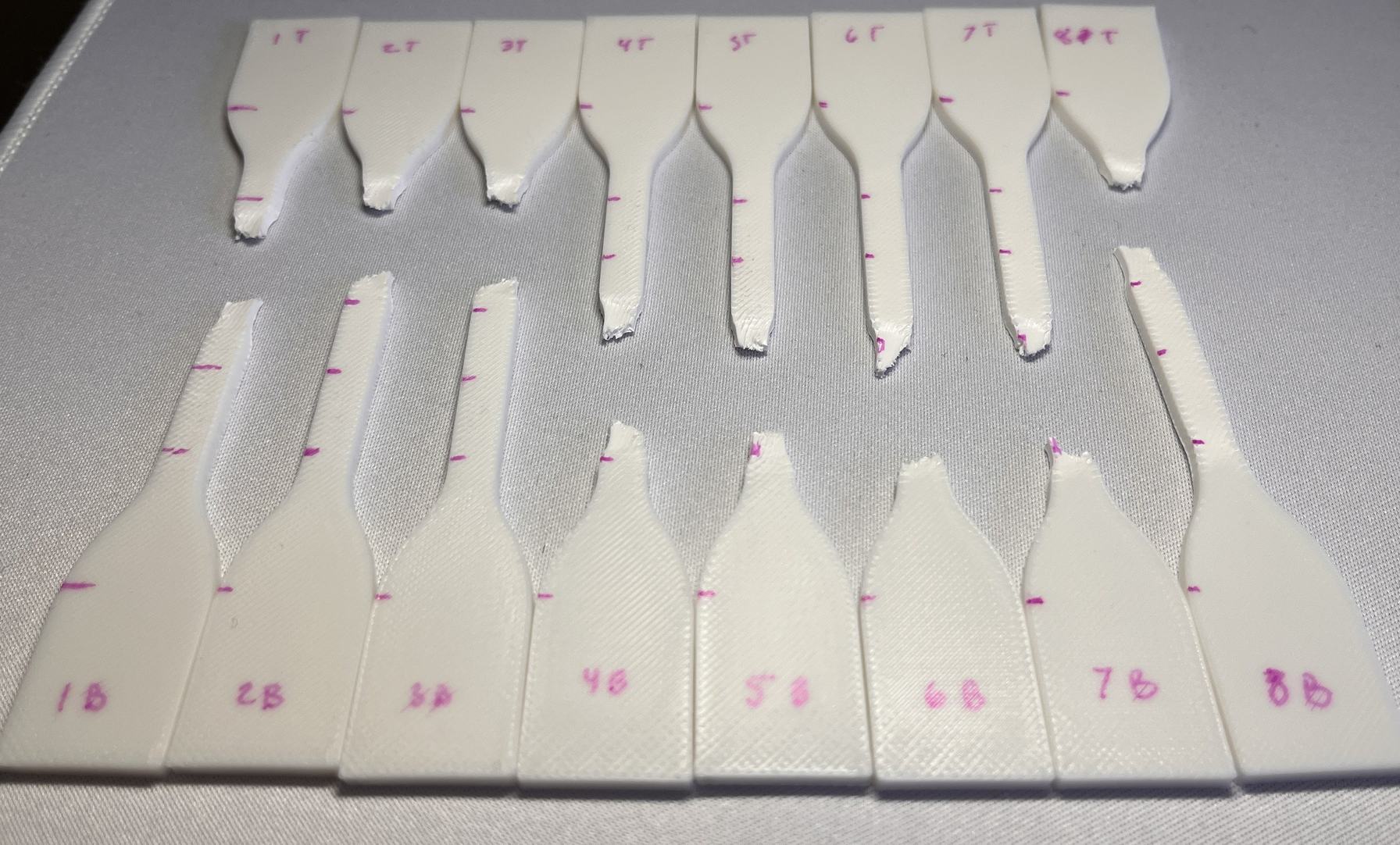
Both standards require at least ten specimens per material, split five and five across orientations when the material is anisotropic, and FFF parts always are. So: three materials (virgin PLA, uncontaminated tPLA, contaminated tPLA) by two configurations by five specimens by two tests. Sixty specimens.
Tensile specimens were split between a 0° and a 45° starting raster angle, both alternating 90°. Impact specimens were split between z-layer lines parallel and perpendicular to the impact force. Everything printed on a Bambu Lab A1 Mini, 0.4 mm nozzle, 0.20 mm layers, two wall loops, 100% infill.
Defining the elastic region without eyeballing it
Young’s modulus and yield stress both depend on where you decide the elastic region ends, and on a polymer stress-strain curve that boundary is not obvious. A judgement call there propagates into every number downstream.
Rather than pick it by eye, I transformed true strain against true stress into a log-log plot and took the first range whose slope sits between 0.9 and 1.1, since linear in log-log means linear in the original, requiring two sequential values inside that band before accepting it. Any qualifying range after the first was treated as plastic.
That makes the elastic region determination repeatable across thirty specimens and three materials instead of thirty individual judgements.
Knowing what the machine cannot tell you
The Tinius Olsen IT542 resolves meaningfully to about a tenth of a joule. It is built for materials tougher than PLA, so a PLA impact specimen sits near the bottom of its useful range, and every impact figure in the paper carries that limitation.
Each specimen was also logged by failure type, complete, hinge, partial or non break, so the failure mode is recorded alongside the energy rather than collapsed into a single number.
Results
Young’s modulus differs across every comparison, at every raster angle, with p-values down to 1.4x10⁻¹². That is the talc and the impurities changing the elasticity of the material, and it is unambiguous.
UTS and yield stress are mixed. Yield stress separates PLA from both recycled variants at 45°/45° and not at 0°/90°. UTS separates some pairs at one raster angle and not the other. The raster angle matters as much as the material does.
Virgin PLA elongates substantially more before breaking, consistent with the necking visible during testing and with the recycled material being more brittle.
And the result that matters most: on impact strength, PLA differs significantly from both recycled variants, but contaminated and uncontaminated tPLA are not statistically different from each other. Contamination does not meaningfully degrade the mechanical properties.
So the problem is printability
Contamination shows up in processing instead.
Contaminated filament clogs the 0.4 mm nozzle. Clearing it takes a cold pull, feed at extrusion temperature, cool to 100 °C, extract backwards through the nozzle, and what comes out is visibly loaded with contaminant: food residue not removed in washing, or non-tPLA cutlery that got into the collected sample.
Upstream, contaminants cause bulges during extrusion that push the filament outside the ±0.15 mm diameter tolerance FFF needs, and cause die drool that can attach to the filament line and do the same thing.
One honest caveat. Print parameters including extrusion temperature were held constant across all materials, and tPLA is more thermally resistant than PLA. Some of the observed defects, over-extrusion, stringing, layer overlap, may come from uncontrolled rheology and melt flow differences rather than from contamination. This experiment does not fully separate the two.
The energy case
The full secondary process, washing, grinding, dehydrating, extruding, spooling, printing, costs 18.57 kWh per kg of filament against 32.65 kWh/kg for primary production. Reusing PLA takes 56% of the energy of making it new.
Peter Fabe, Koda Mitsuhashi, Benson Jiang, Parth Vaishnav, Daniel Cooper. Forks to Filament: Exploring the Potential Viability of Post-Consumer tPLA in Additive Manufacturing. Proceedings of the ASME 2025 International Design Engineering Technical Conferences, August 17 to 20 2025, Anaheim, California.