Light-Actuated Shutters
A graphene, PDMS and aluminium trilayer that opens and closes itself under light, and six blade geometries to find out what drives the motion.
- Role
- Sole undergraduate researcher. Design, fabrication, cyclic testing, analysis. First author.
- Context
- UROP, Prof. Young Geun Park's lab, University of Michigan
- Dates
- September 2023 to August 2024
- blade geometries designed and tested
- 6
- reversibility over the industry norm
- 10×
- samples fabricated
- 100+
Self-actuating structures move in response to their environment rather than to a motor, which makes them interesting for harvesting ambient energy that otherwise does nothing. The existing designs actuate well and then wear out. The stress and strain of actuating deforms them, so they don’t survive repeated cycles.
This project builds a light-responsive structure that opens and closes itself and keeps doing it, targeting reversibility roughly ten times the industry norm.
How it moves
The actuation comes from stacking materials that disagree about temperature.
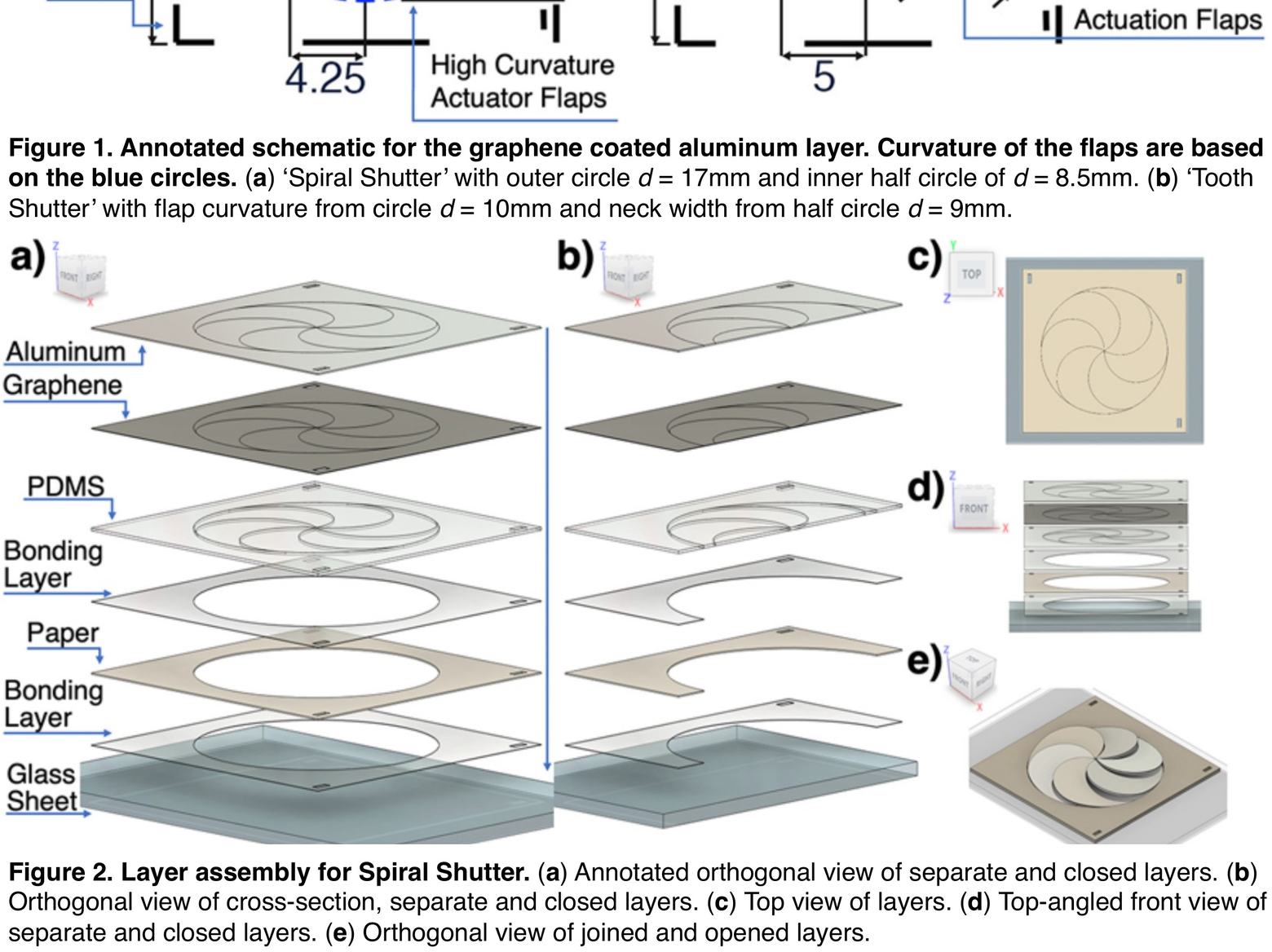
Graphene has a negative coefficient of thermal expansion (−3.26 µm·m⁻¹K⁻¹). PDMS has a strongly positive one (310 µm·m⁻¹K⁻¹), aluminium a moderate one (23.03 µm·m⁻¹K⁻¹). Sandwich graphene between the polymer and the metal, bond the stack to a low-expansion glass base through a pressure-sensitive adhesive layer, and heating the assembly makes the PDMS expand while the graphene does not. The bonded layers can only resolve that mismatch by bending, so the flaps curl outward.
Light rather than a hotplate drives it in use, and that is why the metal is there: graphene and aluminium both conduct heat well, so incident light converts to heat and distributes through the stack efficiently instead of pooling where it lands.
Why six geometries
The material stack determines that it moves. The blade geometry determines how much, in which direction, and whether it can do it again.
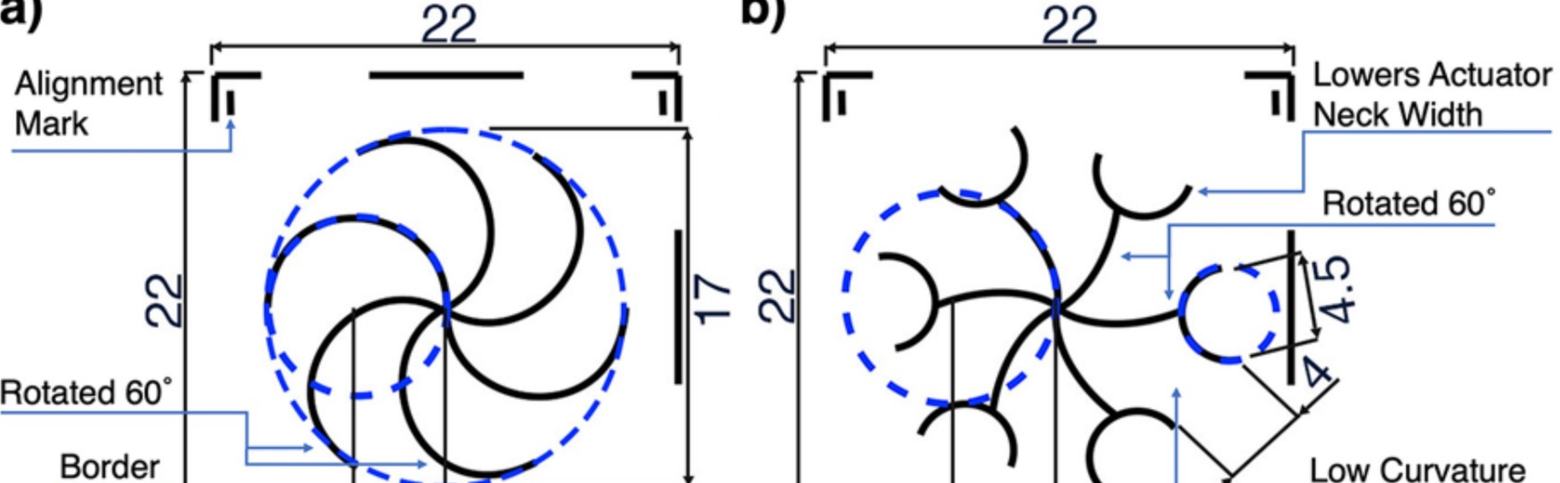
I designed six hexagonal shutter patterns, spiral, tooth, hook, wide hook, arrow-hex and tri-hex, varying two parameters deliberately. Flap curvature is set by the radius the blade edge is struck from. Neck width is the narrowed section where the flap meets the fixed frame and where the bending concentrates.
Fabrication
PDMS mixed 10:1 elastomer to curing agent, laminated to PSA. Graphene-coated aluminium laminated to PSA separately. Blade patterns cut from both composites plus a PSA layer, with a paper pore layer for the open-at-high-heat variants. Plasma treatment around the design perimeter for one minute to bond. The closed-at-high-heat variants get a pre-bake at 100 °C for eight minutes before plasma treatment, so they are assembled already strained and relax the other way. Final assembly onto PSA/glass with a 2-minute bake.
Over a hundred samples, because the process has a low yield and the parameter study needs replicates at every geometry.
Cyclic testing
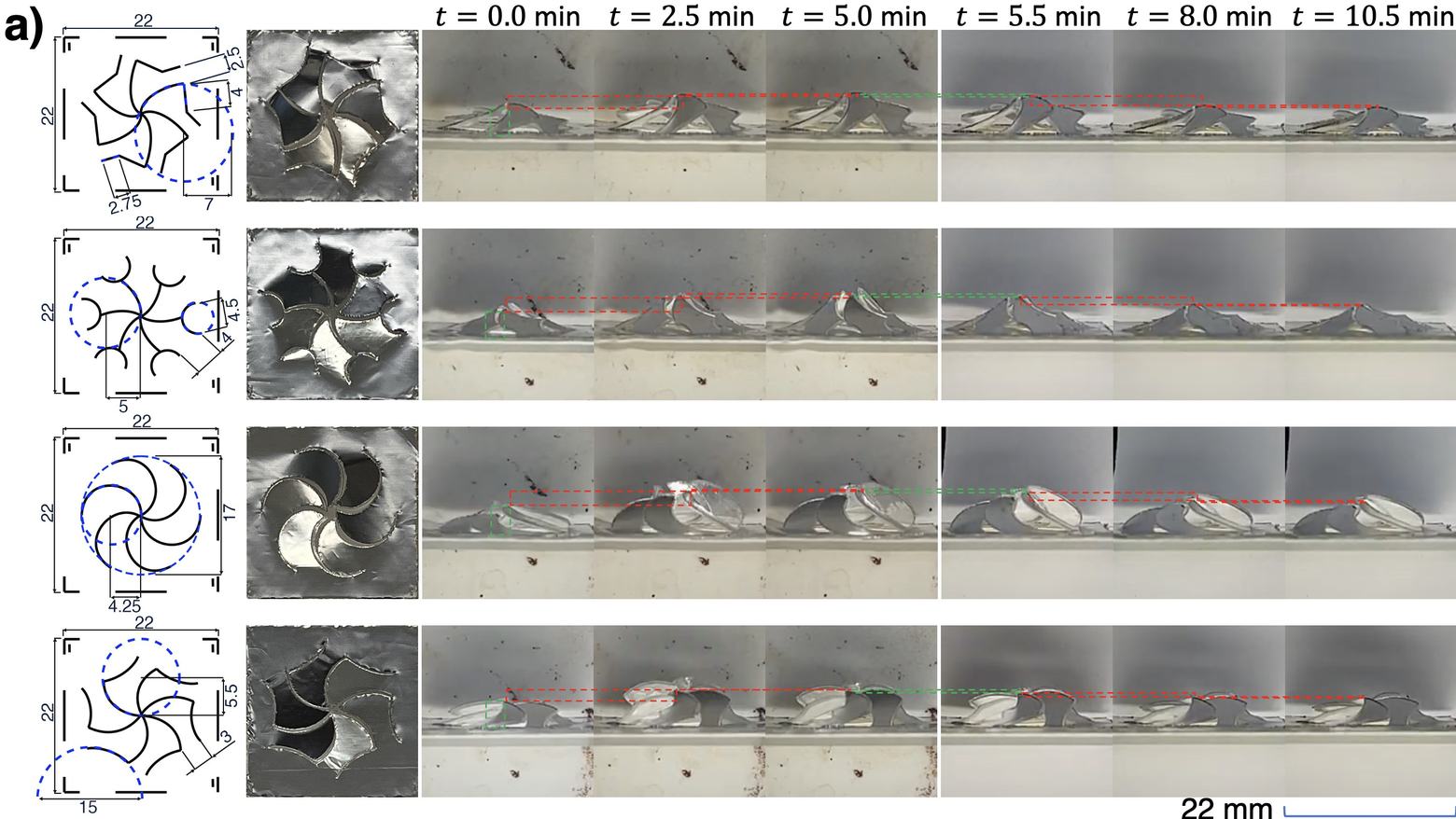
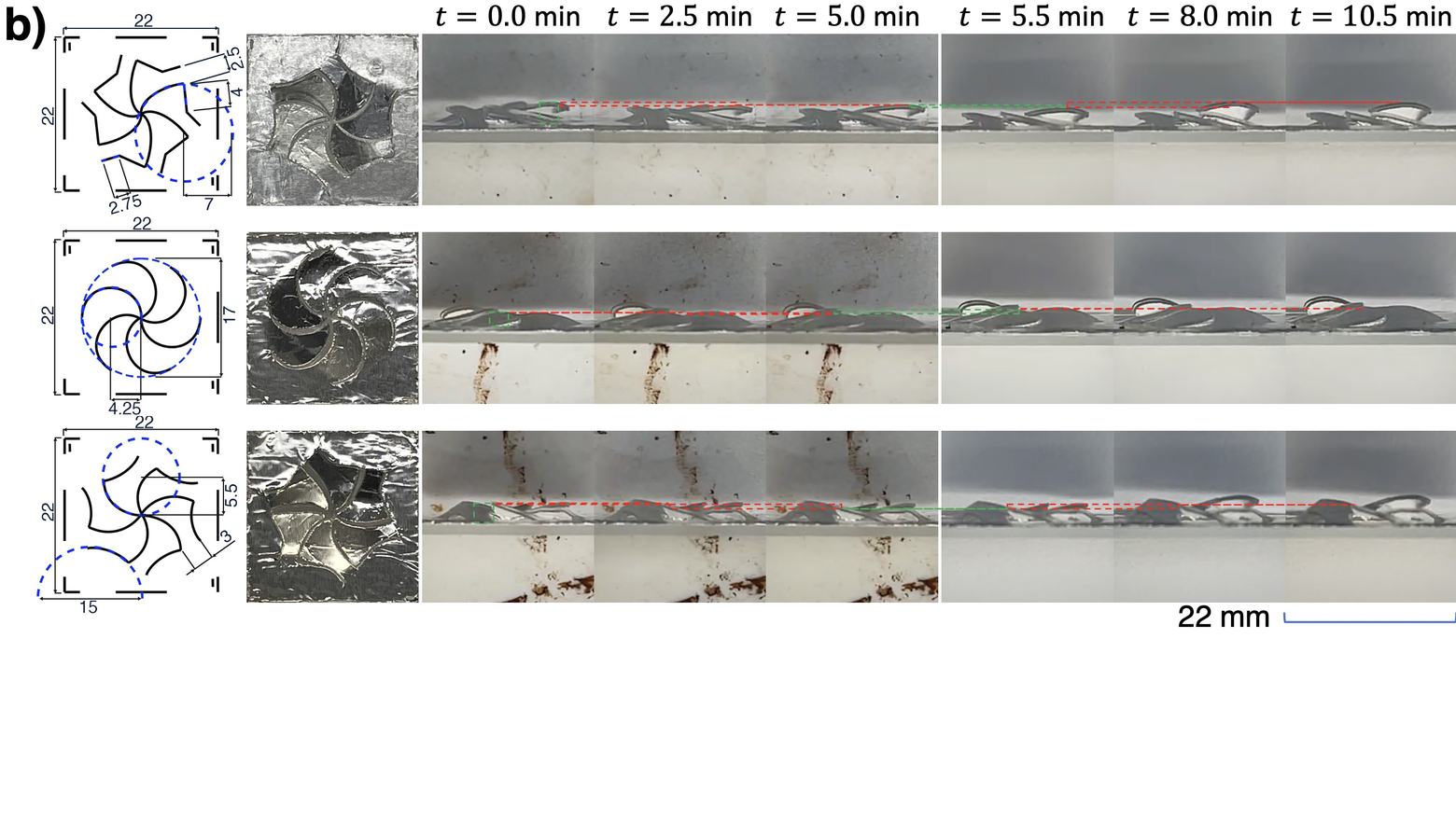
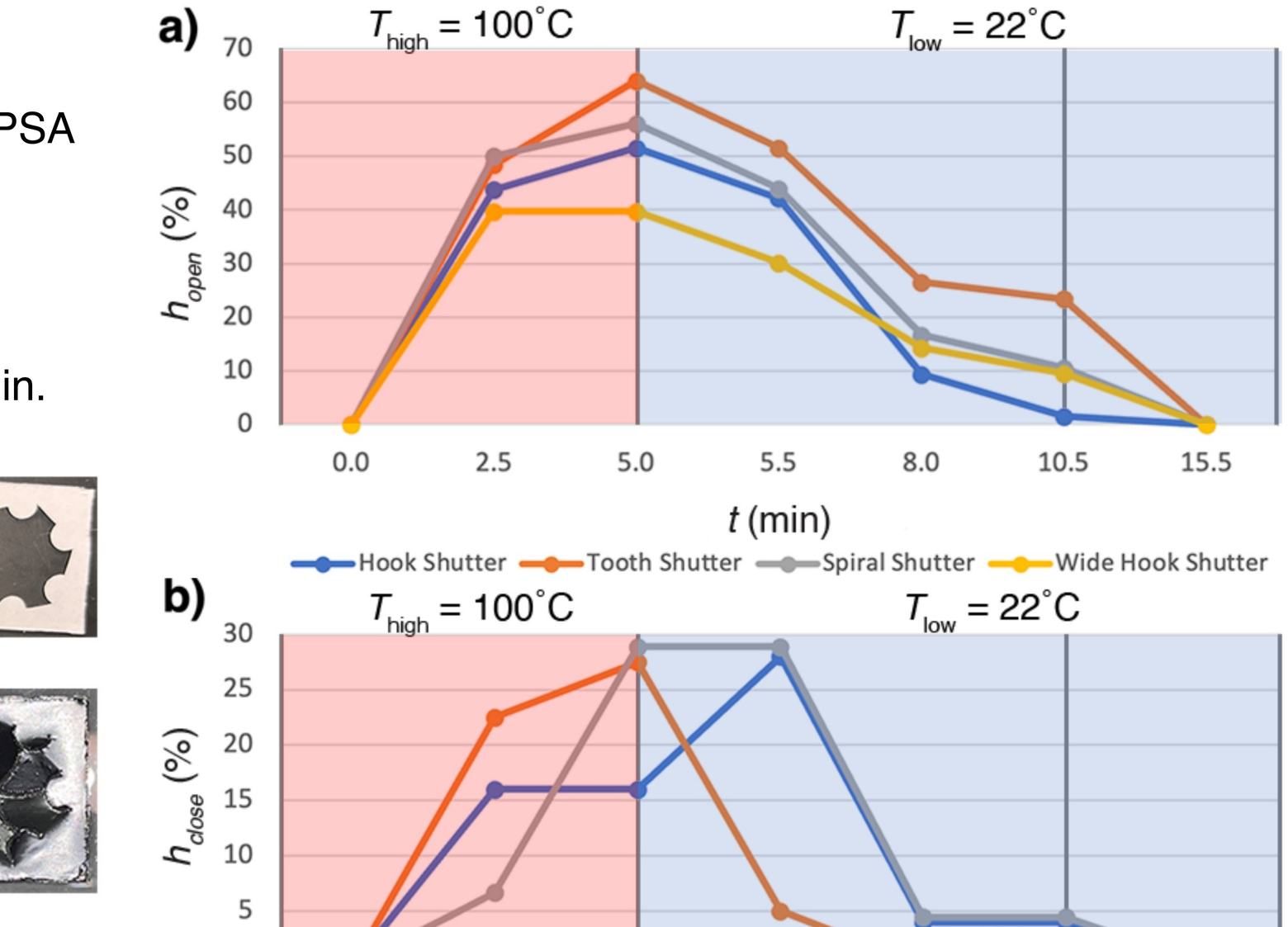
Each design was cycled between 100 °C for five minutes and 22 °C for five and a half, with opening and closing height measured as a percentage of full travel across the cycle.
What the geometry does
Higher curvature actuates further outward. The more strongly curved blades move more sideways and out; the flatter ones lift less.
Narrower necks increase actuation, up to a point. Concentrating the bend in a smaller section gets more motion out of the same strain mismatch, until the neck gets thin enough that it becomes the failure site.
Blades collide with each other. Several designs, the hook shutter worst among them, physically impede their neighbours partway through opening. The limit is interference, not the material, and it appeared most in the closed-at-high-heat configurations.
Opening is faster than closing. Actuation under heat happens quicker than the reverse relaxation on cooling, and the closed-at-high-heat structures were the least consistent overall.
Where I’d take it
Indenting the neck to target where the bend initiates, rather than letting a narrowed section decide it. Redesigning the blade envelopes so they can’t interfere across their full travel. And reworking the layer stack to reduce the residual strain that accumulates and eventually deforms the structure, which is the original problem this was trying to solve.
Supervised by Prof. Young Geun Park. Zeina Jebara, an upperclassman in the lab, taught me the fabrication equipment and process.